



 TEL:13615481234


How are the types of gantry crane tracks classified?
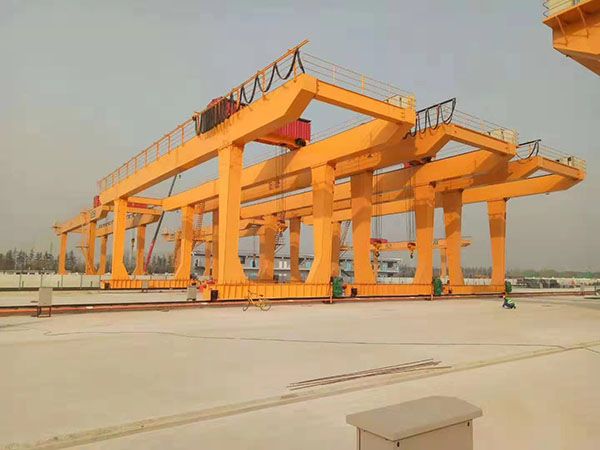
As a manufacturer of gantry cranes in Shandong, today I would like to share with you how the types of gantry crane tracks are classified?
When purchasing or renting a gantry crane, users need to distinguish the span, lifting height, speed, working level, usage environment, and spatial dimensions of the site. Generally, the tracks provided include light rail and heavy rail.
The track includes crane rails, railway rails, and square steel. The top of the steel rail is raised, and the bottom is a flat plate with a certain width, which increases the contact surface with the base. The cross-section of the guide rail is mostly I-shaped, with good bending strength. Square steel can be regarded as flat top steel rails. Due to the wear of the wheels, it is usually only used for cranes with small lifting capacity, slow operating speed, and low working frequency. Steel rails with a weight greater than 30kg/m are considered heavy rails.
The standard rail length comes in 12150m and 25100m2 specifications. The quantity of rails for light rail is not more than 30 kilograms per meter, usually with a length of 5? 12 meters. The steel used for light rail is mostly killed steel and semi killed steel of ordinary carbon structural steel. In order to improve the wear resistance and corrosion resistance of rails, low-alloy structural steel with alloy elements such as Mn, Si, P has been adopted in recent years.
In order to ensure the safe operation of the gantry crane, the large vehicle walking track of the crane must be fixed on the walking foundation, and the small vehicle walking track must be fixed on the main beam. When the crane is working, the track cannot move horizontally or vertically, and the track should be easy to adjust.
| Previous:How to adjust the extension and retraction of the gantry crane arm? | Next:What are the maintenance methods for bridge cranes |



 Home
Home
 Tel
Tel
 Product